30.5.20

Collage Art - A broader narrative for the New World, and the storm before the drought

Typically, I make collage pieces without a plan. Rather, I let the available images I am cutting come together in the moment. As a result, most of my pieces tend be rather surreal. They often lack specific themes (though I may interpret the result after completion) or image structure. Beyond a gut feeling as to the aesthetic of the disparate images in juxtaposition, I feel I have little directorial role in the outcomes. In that sense, my collages are rather process-oriented.

One year, the Beatnik Lounge and Gallery (in Joshua Tree) was holding a Thanksgiving show, and I wanted to create a special piece for the event. Many of the shows there challenged me to consider the title or theme's deeper implications. I had been considering the "traditional" (you know) images of the first Thanksgiving and the overly reverent, Hallmark-style white-washed nostalgia that always attends such classical American traditions. While I am not a particular advocate of wholesale dismissal of beloved cultural symbols, they often provide only a limited view or narrative. There is always more than one way of looking at things.

The U.S. Capitol Rotunda bears a classic piece of American art (as in, before we produced any decent art, in my opinion) commemorating the landing of Columbus in the near world. It was painted by John Vanderlyn. The painting clearly seeks to portray the European Age of Exploration and embedded ideas best suited to promote the nascent Republic and its Manifest Destiny. A crowd of prayerful and celebratory white men make landfall on a wild shore. It is meant to show a Terra Nullius despite the lurking indigenous presence. Natives are squeezed to the background, cowering and worshipful at the edges of the forest. It is a motif that has existed in multiple forms. For reference, the original painting is at the bottom of this post. It was originally positioned here, but I do not want to give it pride of place.

For this show, I wanted to a produce a response to it that incorporated the similar layout and impression while rebutting and broadening the original historical perspective. If this is to be a symbol of America, I wanted it to incorporate a more beautifully varied and often contradictory collection of narratives. All the better to represent and celebrate the diversity that makes up the sort of America I feel is worth celebrating.

As a piece of work, this was a major departure for me. I uncharacteristically approached this with an outline of the layout. While the individual component parts were serendipitously culled from the print materials I had ready access to (Smithsonian and National Geographic magazines, issues of Time and AAA monthly, brochures and travel periodicals from thrift stores...), they would all be fitting into a larger pictorial that would match the original painting. Furthermore, I was working at a scale I had never before attempted. Most of my collage works ranged in size anywhere from that of a postcard to a legal sized sheet of paper. The finished piece, shown below is about four feet in length. It consists of over 100 individual images and pieces of paper that were cut, arranged, overlaid, and glued together by hand.

As I have been writing this, I realize is far better articulated by Terese Marie Mailhot, "the truth of my life as an Indian woman has asked that I hold many things: white histories and my people's and other nation's stories, passed on and unwritten but still living. As an indigenous person, in order to find the true history of other indigenous nations, I must remind myself that history doesn't exist in a linear progression; it's duplicitous and not always found in books. So much has been erased, and too much still has to be uncovered."

An obvious title presented itself as I completed the piece: "E Pluribus Unum." Out of Many, One. The America I want to call home is home to many like and unalike. It is a diverse place, and big enough to handle and embrace many different people and stories. A messy work in progress.

E Pluribus Unum (2016)

It is not a great photo. Difficult to get it without a light source washing out some portion of the image. And way to big for me to scan.

That show was in November of 2016. While the celebration this art was meant to embody was sucker punched, it was ever so needed.

Landing of Columbus (1842-47), John Vanderlyn


21.5.20

Quarantine Art - Unkowning My Place

Unkowing My Place, 2020.
This one is a little too large for the scanner, so I had to take a crappy picture with my phone. The elements have been floating around for a while, but they all really came together in the last couple days.

Quarantine Art - New technique experiment

Stop, 2020.
This is a small experiment in a new technique I want to explore in my collage work. At present, it is very labor-intensive and so this piece is rather small.

I hope to create more of a series with these, incorporating visual elements of Australian indigenous art, Verner Panton, and psychedelia into my already somewhat surreal aesthetic.

Quarantine Art - Fickle Miracles (unfinished)

This piece is not quite finished, but it is getting close. I have a tendency to fill things up just because I can (or there is the room to do it). I do not want to do that here, but I feel that there are a couple finishing touches that have yet to present themselves.

It is a bit too large to fit in the scanner, so a quick phone-snap will have to do for now.

Fickle Miracles, 2020

Quarantine Art - Arts & Sciences

Arts & Sciences, 2020.

6.5.20

Quarantine Art - Experiment in Abstraction


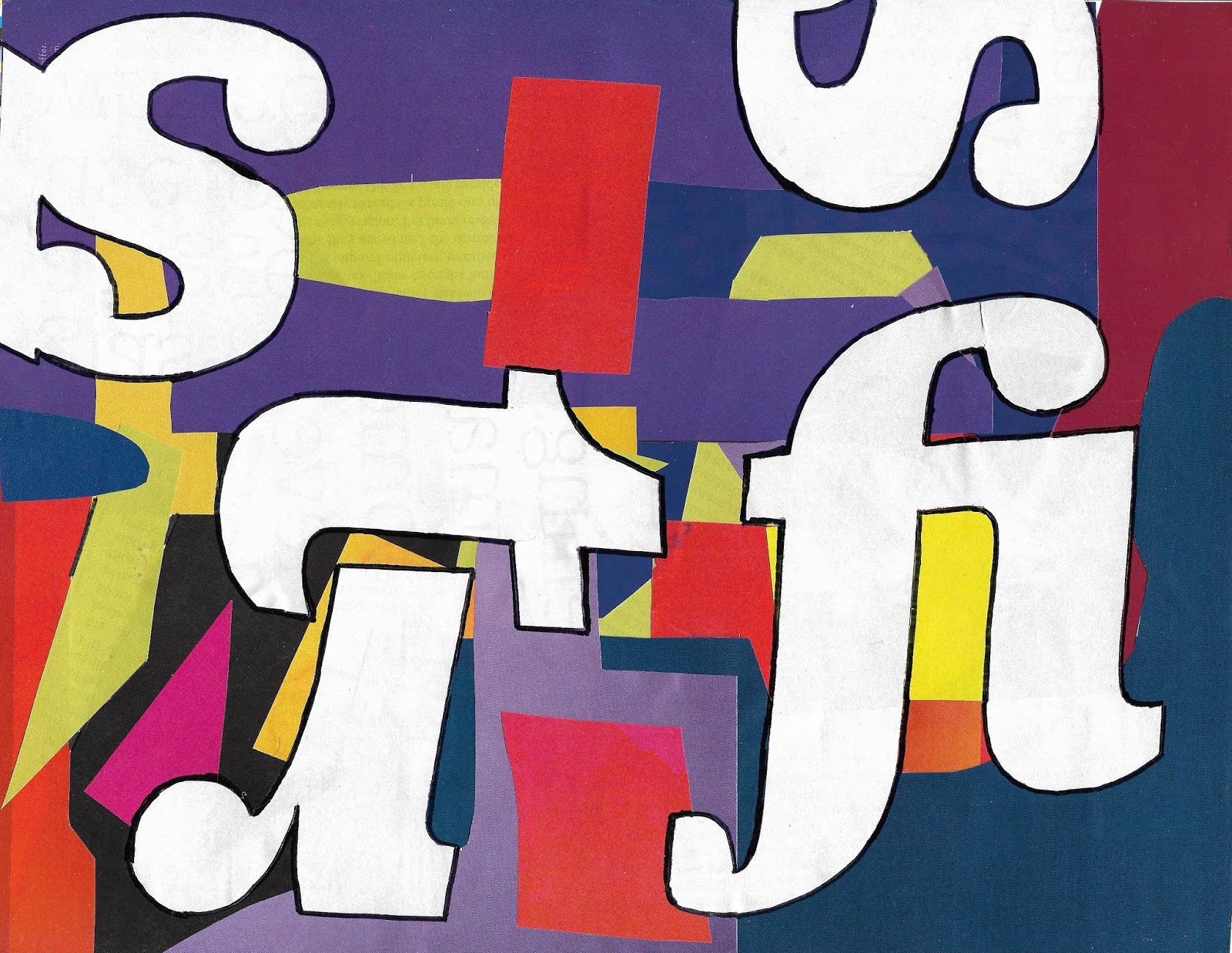
Firsts (2020)
I have long been fascinated with the transition undertaken by both Piet Mondrian and Wassily Kandinski from figural to abstract painting. Every once in a while, I feel the pull in my own collage work to move from the figural, albeit surreal, juxtapositions to less representational images.

Inspired by several sleepless nights, I once created a triptych of swirling and amorphous black pieces of paper to capture the feeling of my mind speeding up after turning off the light.

I have found a lot of bold, blank colours in the magazines I have been cutting up for my collage. A pure abstraction of such hues was the first inspiration. However, I felt it would be quite flat. An article's title page presented an appealing script of the word "firsts". When isolated from type-set and syntax, the letters themselves become their own shapes. Language is a system of agreed-upon symbols. However, the scripts of written language are not universal symbols. The inherent contradictions appeal to me. In my travels, I have meandered through venues where foreign scripts I cannot read remind me that illiteracy is a relative concept.

22.4.20

Quarantine Art - Snow White

Snow White (2020)

Quarantine Art


This site has gone through multiple concepts and iterations. From its nascent form as a noise-collage and art receptacle as part of the Art Nausea/Ad Nauseam collective, to its repository of silly anecdotes and musings on life, to an inspirational/informational travel log for studying abroad, Randamnation has always been a creative outlet for the madness normally well-retained between my ears.

It has been quite some time since I documented anything on this site. In the midst of my vexations and fatique from grad school, the disruptive power of the COVID-19 pandemic, the subsequent quarantine and adaptation to location-limited life, I have wanted to renew the long-paused work I have done in collage art.

So, I hope to make it a regular habit to produce the strange, silly, and sad accretions I cut and paste out of the stacks of print materials at my disposal. Perhaps I might even post them here.

For example, some poor photos of works I did years ago. I cannot remember the titles, but they were made between 2015 and 2017 for group shows at the Beatnik Lounge in Joshua Tree.

Made for a show coinciding with a UFOlogist convention

Honestly wish I could remember the title or the show

More to follow...hopefully