10.5.15

Freddays around the Cape

I am very grateful that my love managed to come to Cape Town for a month to help break up the time we are spending apart as a result of my international studies. Fred flew to Johannesburg where I met him for my mid-semester break. During that time, we went on an amazing 5-day camping safari in Kruger National Park (with the equally amazing Armadillo Overland Tour Company...thank you to Nicky and Chris!).

We then came back to Cape Town, where Fred spent the next three or four weeks going on adventures, letting me tag along and/or drag him on other adventures, and hanging out while I freaked out over schoolwork. The poor dear spent a fair amount of time in Africa hanging out in malls while I ran to treatment centres to see sponsees or sat tearing my hair out over archaeological papers.

I wanted to get some pictures up of our time together, because he is a major part of my life and a wonderful addition to my time spent in South Africa.


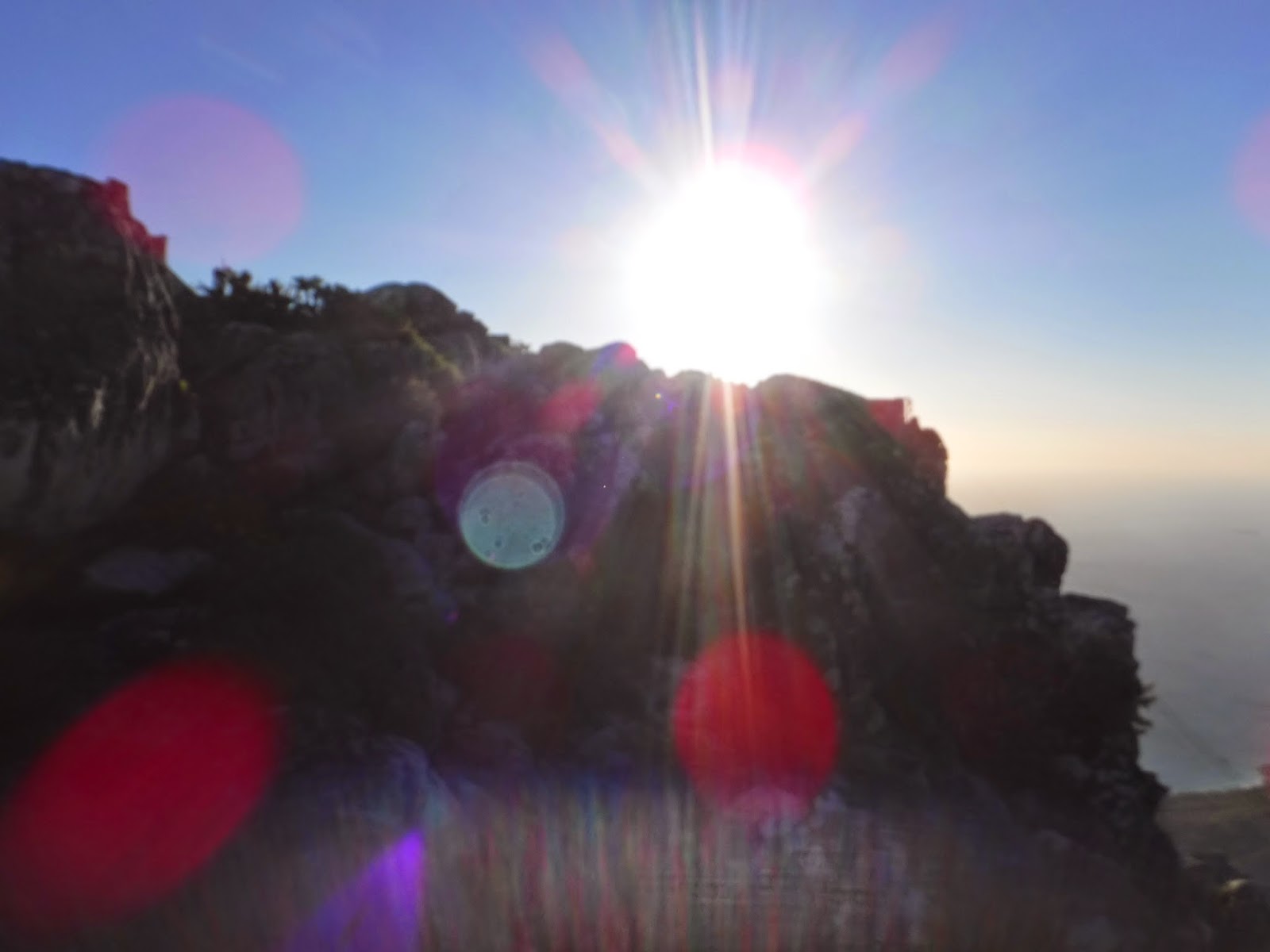
On a clear, seemingly windless day we decided to brave long lines and load shedding to take the aerial tram up to the top of Table Mountain. Fred is not a fan of heights, the poor dear, but was a trooper.


Our usual enjoying-ourselves look.


On another weekend, we joined Mandolyn and Paarth and took the train out to Muizenberg to go to the beach. Well, I sat in a cafe to do my school work as I was typing a paper...beach sand and laptops are not the best of friends. Monkey came along as well.


Among other things, we enjoyed the Ethiopian restaurant on Long Street, discovered the Hussar Grille in Rondebosch, strolled through Bo Kap, a performance of Cabaret at the Fugard Theatre...

Fred also took a township tour, which sounds amazing. I hope to go on it at some point soon.

Through Ida Cooper, we also got to go to Robben Island, the Alcatraz of Cape Town, where enemies of apartheid, such as Robert Sobukwe, Nelson Mandela and other leaders of the ANC were imprisoned. We went with Paarth and a couple other American students, but go separated from them when busses were loading to take us on the tour of the island.

The trip was very intense and highly emotional. It was powerful to see and hear about the conditions to which those who opposed the apartheid government in South Africa were subjected. At the same time, the tour was conducted by a former prisoner who talked about the healing power of being there as a guide rather than as a prisoner and how he learned to forgive. It was also incredibly powerful to learn that the sanctions and protests and boycotts that the rest of the world imposed upon South Africa during those times actually reached the inmates on the island. As a result, they received somewhat better conditions and took comfort in knowing that what they were doing would not be in vain. It was heartening to learn that those seemingly insignificant pieces of political action we took back in the day (and in some cases continue to take now) do matter and impact people in a very real and positive way.


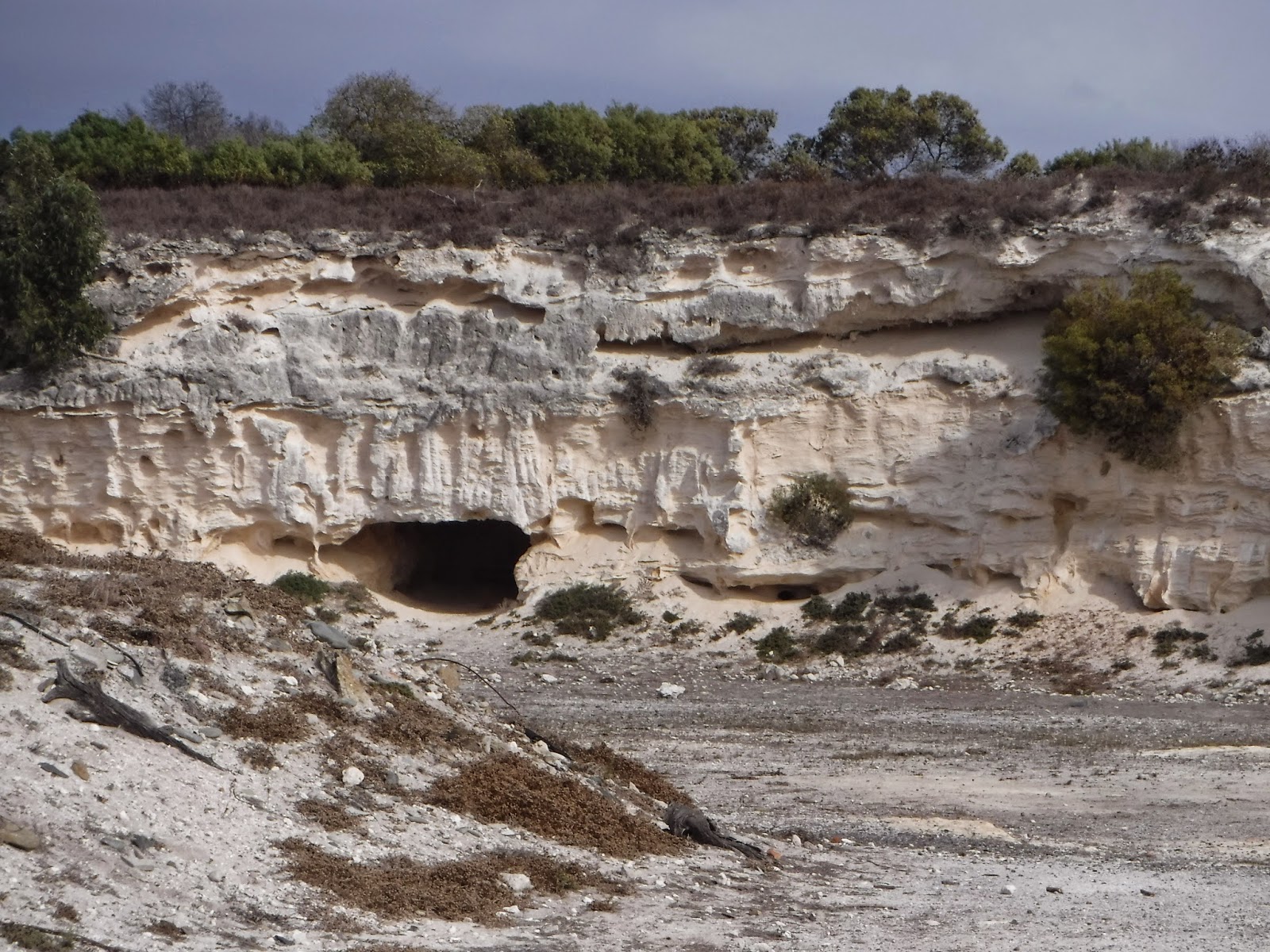
The quarry where ANC leaders were subjected to hard labour. The limestone dust coated their lungs, and the stone reflected the intense sunlight, which is why many of the former prisoners (including Mandela) had lung and eye troubles.

Upon his visit as president, Mandela encouraged all attending to create a pile of multicolour stones in the former quarry to symbolize the coming together of South Africa's people.

A former inmate takes us into the prison.


Many of the cells and group rooms had interesting bits of decoration.


An African penguin, oblivious to history, takes up voluntary residence in the prison.


The garden where the manuscript of Mandela's autobiography was hidden from the guards

Nelson Mandela's cell

Before the international protests brought int the bunks seen in other pictures, the prisoners slept on these mats.


It was a grey day returning to Cape Town.


When hitting the deck beats missing it...

Just last weekend, my Marine Ecosystems class took a field trip to Soetwater outside Kommetjie (fun Afrikaans names that most of you will likely have fun misprounouncing). This was not the blindingly brilliant state-of-art research facilities I encountered through the University of Queensland last year. In fact, this facility was not directly related to the University of Cape Town at all. Rather, it appears to be a private, or semi-private educational retreat-type facility on the west coast of the Cape. It was a quaint little place that provided our basic needs.

Our class was split into three teams that would cycle through the research projects hosted by each of our lecturers over the three days of the field trip. I am reminded of Ian Tibbetts last semester saying "I don't do structure, I do science."

I have to admit that I learned more of my classmates names over that weekend than I had in the preceding bulk of the semester. It was nice to finally get acquainted, rather than sitting in lecture and then running off to my next lecture. As I mentioned before, many of them take a majority of their classes together and have been on this tract since the start of their university careers. So they were much more well-acquainted with each other (and knew the name of the American in the class).

The first afternoon arriving, people flocked down to the shore to watch the sunset and engage in an activity quite popular with South Africans (it seems) called "having a sundowner" which is another way of saying "having a drink as the sun dips below the horizon." A couple of us went out on the boulders of the exposed intertidal to look at a few tide pools. Others tossed the rugby ball around or played soccer.

I somehow ended up with a bunkhouse to myself. There appeared to be more mens bunks than womens, yet there are about half as many males as females in our class. Nobody liked the rather mildewy smell of the top bunkhouse that I went to and quickly sought out the others (which in my opinion had inferior quality matresses). So, I aired out my now massive and solitary accommodations and was quite content. Later, it would prove a blessing to all concerned that I was on my own.

As a forewarning, just about all the pictures I took over that weekend were on the first afternoon.


an itsy-bitsy sea star.


the fog rolls in


the central court of the facility

my lone bunkhouse.


So Friday, my group was to go over to Simon's Town where we would go on a boat to collect some CTD (conductivity, temperature, depth) data on oceanographic conditions in False Bay. They had asked if any of us were keen to do some snorkeling. I raised my hand as keen but unequipped. It turns out us snorkelers would be getting into the water in the marina to do an abalone survey. These highly valuable marine animals were recently discovered there, and a quantification needed to be made in order to monitor for potential poaching events and help promote protection.

Damn that water was cold! Fortunately, one of my lecturers loaned me his wetsuit (something I had never worn in my life). I made it halfway into the wetsuit and decided that covering the bottom half of me would be enough. As soon as I got in and discovered what 11°C (~50°F) water feels like, the rest of the wetsuit slipped on with no trouble. The researcher we were assisting commented that a wetsuit may have never been put on so quickly. While the water was horrificly and inhumanly frigid, the habitat was lovely. I have never seen such clear water in a marina. And the urchins, anenomes, seastars, seagrasses, and abalone were beautiful. It was rough counting and measuring the abalone, and we would take shifts getting out of the water and running into the yacht club's showers to stand with hot water running into our suits. Still, an awesome experience...

The boat came back, and we traded in with the other half of our team. They took the CTD sensors back to the station to organize the data, and we went out on the boat to put down some Baited Remote Underwater Video apparatuses (BRUV) for a fish-count survey. We also did a little fishing. I caught a small pajama shark (someone took a picture, but I have not received it...probably on Facebook somewhere...). After that, we collected our BRUVs and went back to the dock.

I was asked to leap from boat to pier to help tie up the boat. While the details are still a bit hazy for me, I did not stick the landing. Rather, I slipped and flew into the face of the dock and knocked my wind out. While hitting the dock sucked, I am grateful I did not miss it. Had I knocked my wind out and slid into the (remember, very cold) water, I may have drowned. When I could breathe, I discovered that I was also bleeding profusely. The boat was tied off appropriately and first aid administered. Then, we all piled into the combi for a trip to the emergency room!

I ended up getting five stitches in my thumb (my right hand, of course, because my left is useless). I also have a cracked rib and a bunch of bruising. Needless to say, it made the rest of the field trip a bit of a wash. The pain of laying down or sitting up or rolling over meant that my shrieks would have woken the others, had anyone else elected to stay in that one bunkhouse (see, worked out for everyone).

The next day involved gathering CTD data on a heavily developed estuary near Muizenberg, and the day after that was spent on the rocky intertidal gathering data to test the intermediate disturbance hypothesis (essentially, that too much disturbance prevents animals and plants from settling on a surface and that too little means that eventually a small number of species dominates...so the most diversity will be found in situations where a middling amount of disruption occurs). I was a bit flimsy and not able to get my hand wet, so I mostly tagged along for decoration and moral support.

We then compiled the data from all the groups on the different projects. In another week's time we will have to hand in a small write-up of the projects with the data properly analyzed. Wheeee.

It was nice to get back to Cape Town, though it hardly meant that I was healed.

I had no photos of the actual stitches, but here is the high sympathy-profile bandage

my colourful sleeve tattoo of bruises

Gratefully, no infection has occurred with regards to my finger. My stitches have come out and I hotly anticipate a return to function in my right hand. My chest still hurts, and paracetamol has been my friend (acetaminophen), but it appears to be getting slowly better.

Each of the days of the trip, the other groups would report back that they saw my blood on the docks ("On a blood-stained dock in Simon's Town" sounds like the opening line to a Nick Cave song)... I like to think that I left my mark on Africa, and vice versa.


6.5.15

Late update


My apologies for being so remiss in populating this blog of late. I have loads to report, but have had very little time. Things have been very busy, prompting loads of very South African exclamations, like:

"Hectic!"
 and
"Agh, nie" (pronounced "aghck-nee-uh") - essentially Afrikaans for "oh no!"
and
"Eish, shame."

Academically, things really do get stacked in this later 3rd of the semester. While certain time-management shortcomings have contributed, it is also just how the academics at UCT appear to be structured. I have asked several students around campus (with varying degrees of procrastinating tendencies) and they all agree that it is just how it goes here.

I have just in the last two weeks taken three tests, handed in three papers, tried to do some sight-seeing and recreation with Fred, put Fred on a plane back to the States and dealt with missing him, gone on a field trip, and visited an emergency room (I promise more on that soon, mom). I have another test tomorrow, and then it appears that things kind of mellow out for a few weeks before consolidation for final exams to begin.

After my test tomorrow, I think I will be able to breathe (figuratively, if not entirely literally). I intend to do a fair bit of catch-up blogging over the weekend. I will fill in all mysteries then...


I love making promises that I probably cannot keep...


20.4.15

Rhodes(head) Revisited

 Some of you may remember my confusion shortly after arriving in Cape Town about some of the apparent love for Cecil Rhodes. It seemed that despite his legacy as a tyrannical imperialist and capitalist who wanted to tame Southern Africa for white profit and comfort, there was a general acceptance of some level of beneficence from the man. UCT stands on lands donated from his personal estate. He endowed the Rhodes Scholarships. I guess that much of the money for both of these still is coming from the principle in the man's bank accounts (100 years after his death)...he was that rich.

Not the statue on campus. I do not have any pre-protest pictures of that.

However, he is not that loved, especially in some camps. It apparently took some very creative re-interpretation of Rhodes' will to allow non-white students access to scholarships.

In early March, I returned from one of my tutoring sessions in the township (following an already long day) to find a small gathering of people around the Rhodes statue (positioned at the front end of the upper campus so that just about everyone walks past it on a daily basis). People were in a shouting match with a man in a pink hardhat holding a sign that read "Exhibit white arrogance at UCT." There was an odd smell, which it turns out was human feces that has been thrown onto the statue.

I have to admit that I did not linger. I felt that there certainly was white arrogance and a general lack of race talk (much less than I had been lead to expect) at the university. People were remarkably blind in their privilege. However, my exhaustion was strong enough and the smell was repugnant enough to overpower any curiosity.

Little did I realize that that was the kick-off to a string of protests about colonial symbols, lack of university commitment to post-apartheid transformation, and the general institutional racism in UCT. This would result in continued vandalism/decoration of the Rhodes statue, emotional townhall debates, and an occupation of the administration building on campus. Whiteboards were erected to give students a chance to exchange ideas about the topic. Sadly, some of these sank into use for an exchange of flat out bigoted and intentionally insulting opinions.


I have met students who run the emotional spectrum from vitriolic anger over the presence of the statue and other reminders of European subjugation of Africa to "complete apathy." There are some who sympathize with the anger toward the statue but feel there are far more pressing symbols of apartheid and colonialism  (just look beyond at the townships in the Cape Flats, where many people were relocation by the Group Areas Act).

A couple weeks ago, the statue was pulled down. While I believe there is a lot of petitioning to do with regards to the national heritage trust regarding the actual fate of the statue, it was important to a significant portion of the student body, faculty, and staff that Rhodes no longer remain in that central and predominant position on the campus.

I gathered with a large number (some reports read hundreds, others thousands) of people to witness this historic moment. Certainly it may not be on the scale of Mandela's first address to South Africa following his release from prison. However, this removal is an amazing success for student activism. The event is also, hopefully, a re-ignition of the transformation post-apartheid that had seemed to stall out years back. While the country had made amazing leaps coming out of those dark years, things had seemed to settle into a position where not a whole lot had really changed. There are still vast levels of inequality and separation here. The only real difference was that it was no longer held in place by specific laws. It was just maintained socioeconomically.


Amidst dancing, singing, chanting, and cheering (as well as a mostly inaudible speech), the crane lifted the statue off its plinth and put it onto a flatbed to take away. As soon as it was positioned, protesters swarmed the truck, splashing the statue with red paint, draping Rhodes in chains, and whipping him. The jubilation was incredible.

The chains go on. The man in the black t-shirt holding the chains is Chumani Maxwele, the man who initiated the protest.

A reminder as to the power of symbols.

Time will tell whether this will spur the continued transformation in South African society, or even redress the imbalances at the University of Cape Town. The racial make-up of the student body is still disproportionate to the country as a whole. The faculty is even less representative of South Africa. One statue is down.

Who knows how many more will need to come down and how many buildings must be renamed. There are debates over whether history is being addressed, made, or erased. There are still the pressing matters of the massive inequalities that exist in South African society (to say nothing of the rest of the world). Unemployment is still high. The townships are places with intense poverty and sometimes unfettered violence. Kids I work with must walk home from schools in groups to avoid being picked off (or recruited) by gangs. At the same time, these impoverished areas are populated by caring, brilliant people with vibrant stories and incredible potential.

Optimism is a funny thing. It is not something that comes naturally to me. Partially, this is probably due to the fact that it is all about the journey, and not the destination. I do not know if any of us can truly visualize a completely and properly transformed South Africa. It is about having faith in the process.

Beautiful things are happening. I believe that the crushing oppression felt by some and the discomfort felt by the privileged can be ameliorated together.

I have to admit to being saddened by something, however. On more than one occasion, I have overheard conjectures regarding Rhodes' sexuality. The subtext appears to be that a gay Rhodes would be a greater villain, even more of an unnatural invasion upon traditional Africa. My understanding is that part of the decolonization movement is to reject the heteronormative structures imposed upon Africa by Christianity when the Europeans came in. I encourage that movement. We all should be able to find role models and seek out the paths that are best suited to our skills and circumstances. I would hate for those of us who have been un- or under-represented to be turning on each other, thinking that that would be the best way forward for our own empowerment.